Cloud Computing Questions & Answers for GATE CSE & IT Exams.
Demystifying the Cloud: Architecture, Benefits, and Deployment
Cloud computing has transformed from a tech-industry buzzword into the foundational infrastructure of the modern digital economy. At its core, cloud computing is the on-demand delivery of computing services—including servers, storage, databases, networking, software, and analytics—over the internet on a pay-as-you-go pricing model. Instead of purchasing and maintaining physical data centers, organizations rent access to these resources from cloud providers.
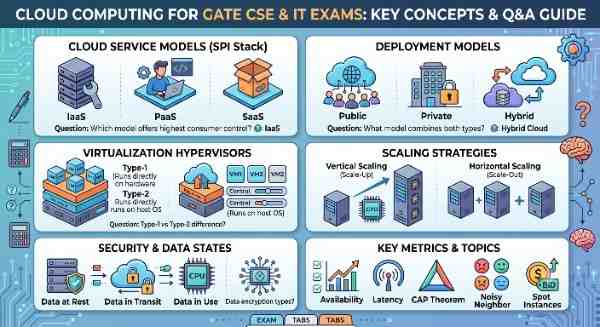
The Cloud Service Models (The SPI Stack)
Cloud computing services are traditionally categorized into three primary service models, each offering varying levels of control and management:
- Infrastructure as a Service (IaaS): Provides fundamental computing blocks like virtual machines, storage, and networks. Users manage the operating system, middleware, and applications (e.g., Amazon EC2, Google Compute Engine).
- Platform as a Service (PaaS): Offers a hardware and software tools environment tailored for application development. The cloud provider manages the underlying infrastructure, allowing developers to focus purely on deployment (e.g., Heroku, AWS Elastic Beanstalk).
- Software as a Service (SaaS): Delivers fully functional, end-user software applications directly over a web browser, completely managed by the vendor (e.g., Google Workspace, Microsoft 365).
Key Deployment Models
Organizations deploy cloud infrastructure across different environments based on security, compliance, and architectural needs:
| Model | Description | Primary Use Case |
| Public Cloud | Resources owned and operated by a third-party provider, shared across multiple tenants over the public internet. | Cost-effective scaling, startups, web applications. |
| Private Cloud | Infrastructure dedicated exclusively to a single organization, hosted either on-premises or by a third party. | Highly regulated industries, strict data compliance. |
| Hybrid Cloud | Combines public and private clouds, allowing data and applications to move seamlessly between them. | Balancing legacy systems with scalable public cloud burst capacity. |
Core Core Benefits of Cloud Adoption
- Cost Efficiency: Shifting from Capital Expenditure (CapEx) for hardware to Operational Expenditure (OpEx), paying only for consumed resources.
- Scalability & Elasticity: Dynamically scaling resources up or down to match real-time traffic spikes or seasonal declines.
- Global Accessibility: Enabling seamless remote collaboration by ensuring applications and data are accessible securely from anywhere worldwide.
- Disaster Recovery: Providing built-in redundancy across geographically distributed data centers to prevent data loss.
Here is a comprehensive compilation of technical questions and direct answers for Cloud Computing, structured for GATE CSE and competitive IT exams.
Part 1: Cloud Architecture, Models, and Virtualization
Q1. What is the fundamental difference between Type-1 (Bare-Metal) and Type-2 (Hosted) Hypervisors? Answer: Type-1 hypervisors run directly on the host machine’s physical hardware, offering high efficiency and low latency. Type-2 hypervisors run on top of an existing host operating system, introducing abstract overhead.
Q2. In a public cloud, who is responsible for physical security versus data encryption under the Shared Responsibility Model?
Answer: The cloud service provider (CSP) is responsible for physical security (data centers, hardware), while the consumer/customer is responsible for data encryption (data at rest and in transit).
Q3. Which cloud service model (IaaS, PaaS, SaaS) provides the highest level of consumer control over the underlying operating system?
Answer: Infrastructure as a Service (IaaS).
Q4. What is the difference between Full Virtualization and Para-virtualization?
Answer: Full Virtualization does not modify the guest OS; it intercepts binary instructions via the hypervisor. Para-virtualization requires modifying the guest OS kernel to make hypercalls directly to the hypervisor, improving execution speed.
Q5. Define ‘Multi-tenancy’ in cloud computing. Answer: Multi-tenancy is an architecture where a single physical instance of a software application or hardware infrastructure serves multiple distinct user groups (tenants), while securely isolating their data.
Part 2: Storage, Networking, and Resource Management
Q6. Differentiate between Object Storage and Block Storage regarding data accessibility.
Answer: Block storage breaks files into distinct blocks with unique addresses, acting like a hard drive (best for OS and databases). Object storage treats data as discrete units paired with metadata and a unique identifier, accessed via REST APIs (best for unstructured data).
Q7. What is the difference between vertical scaling (Scale-Up) and horizontal scaling (Scale-Out)?
Answer: Vertical scaling adds more power (CPU, RAM) to an existing single machine. Horizontal scaling adds more machines/nodes to the existing pool of resources.
Q8. What mechanism does a Cloud Load Balancer use to ensure high availability?
Answer: Health checks (periodic pings or requests sent to target instances to route traffic only to healthy nodes).
Q9. Explain the ‘Cloud Bursting’ deployment model.
Answer: An application deployment configuration where an organization runs its primary workload in a private cloud or local data center, but “bursts” into a public cloud when demand spikes to prevent downtime.
Q10. What is an ephemeral disk in a cloud virtual machine?
Answer: A temporary storage drive physically attached to the host machine that loses all its data when the virtual machine instance is stopped, terminated, or fails.
Part 3: Advanced Concepts, DevOps, and Edge Computing
Q11. What is the primary operational difference between Virtual Machines (VMs) and Containers?
Answer: VMs virtualize the underlying hardware and include a full guest OS. Containers virtualize the operating system kernel, sharing the host OS, making them lightweight and faster to boot.
Q12. Define ‘Serverless Computing’ (Function-as-a-Service).
Answer: A cloud execution model where the cloud provider dynamically manages the machine resource allocation and execution of code. Users are billed based on execution duration and triggers, rather than pre-allocated server capacity.
Q13. How does Edge Computing complement Cloud Computing?
Answer: Edge computing processes data closer to the source (IoT devices, local sensors) to reduce latency and bandwidth usage, while cloud computing handles centralized, heavy data processing and long-term storage.
Q14. What is ‘Vendor Lock-in’ in cloud computing?
Answer: A situation where a customer becomes dependent on a specific cloud provider’s proprietary tools, APIs, and configurations, making it highly costly or complex to migrate to another provider.
Q15. What mathematical formula represents Availability (A) in terms of MTBF (Mean Time Between Failures) and MTTR (Mean Time To Repair)? Answer:
A=MTBF Divides by MTTR+MTBF
Part 4: Cloud Security, Compliance, and Cryptography
Q16. What is the difference between Symmetric and Asymmetric encryption in cloud data protection? Answer: Symmetric encryption uses the same single secret key to both encrypt and decrypt data. Asymmetric encryption uses a mathematically linked pair of keys: a public key for encryption and a private key for decryption.
Q17. Define ‘Identity and Access Management’ (IAM) in a cloud environment.
Answer: A framework of business processes, policies, and technologies that facilitates the management of electronic identities, ensuring authorized users have specific access to cloud resources based on roles (RBAC).
Q18. What is the Principle of Least Privilege (PoLP) in cloud security?
Answer: The security practice of limiting user and service account access rights to only the bare minimum permissions absolutely necessary to perform their specific job functions.
Q19. Explain the difference between Data at Rest, Data in Transit, and Data in Use.
Answer: Data at Rest is static data stored physically on digital media (e.g., SSDs, object storage). Data in Transit is data moving across a network. Data in Use is active data undergoing processing in system memory (RAM or CPU registers).
Q20. What is a Cloud Access Security Broker (CASB)?
Answer: A software tool or service positioned between cloud service consumers and cloud service providers to enforce security, compliance, and governance policies for cloud applications.
Part 5: Cloud Networking and Distributed Systems
Q21. What is a Virtual Private Cloud (VPC)?
Answer: A logically isolated, private network section carved out within a public cloud provider’s infrastructure, allowing users to run resources in a defined virtual network.
Q22. How does a Content Delivery Network (CDN) minimize latency for cloud users?
Answer: By caching static and dynamic web content at geographically distributed edge locations (Points of Presence) closer to the end-users.
Q23. Define the CAP Theorem in the context of distributed cloud databases.
Answer: A theorem stating that a distributed data store can simultaneously provide at most two out of three guarantees: Consistency, Availability, and Partition Tolerance.
Q24. What is the purpose of an Anycast IP address in cloud routing?
Answer: It assigns a single IP address to multiple physical servers across different locations, routing user requests to the topologically nearest server to minimize network hops.
Q25. Explain the term ‘Microservices Architecture’ in cloud application design.
Answer: An architectural style that structures an application as a collection of small, loosely coupled, independently deployable services that communicate via lightweight protocols (e.g., HTTP REST APIs).
Part 6: Grid, Cluster, Utility Computing, and SLA
Q26. What distinguishes Grid Computing from Cluster Computing?
Answer: Cluster computing connects homogeneous computers over a high-speed local network to act as a single unit. Grid computing connects heterogeneous, geographically dispersed computers over a wide area network to solve a single massive problem.
Q27. Define ‘Utility Computing’.
Answer: A service provisioning model where a provider makes computing resources and infrastructure management available to the customer as needed, charging them based on measurable usage rather than a flat fee.
Q28. What is a Service Level Agreement (SLA) in cloud services?
Answer: A formal contract between a cloud service provider and an end-user that defines the expected level of service, uptime percentages, responsibilities, and financial remedies for outages.
Q29. What is ‘Noisey Neighbor’ effect in cloud multi-tenancy?
Answer: A situation where one tenant monopolizes shared physical hardware resources (like network bandwidth or disk I/O), degrading the performance of other tenants on the same host machine.
Q30. What is the difference between cold migration and live migration of a Virtual Machine?
Answer: Cold migration moves a suspended or powered-off VM to a new host machine. Live migration moves a running VM from one physical host to another without disconnecting the client or causing noticeable downtime.
Part 7: Cloud Performance Metrics, Scheduling, and Fault Tolerance
Q31. What is the difference between Throughput and Latency in cloud data centers?
Answer: Latency is the total time taken for a single data packet to travel from the source to the destination. Throughput is the actual volume of data successfully processed or transmitted over the network per unit of time.
Q32. Define the term ‘Cold Start’ in Serverless / Function-as-a-Service (FaaS) development.
Answer: A cold start occurs when a serverless function is triggered after being inactive for a period, requiring the cloud provider to spin up a new container instance to host the code, which introduces execution latency.
Q33. What is the primary objective of a Resource Scheduling Algorithm like Max-Min in cloud computing? Answer: The Max-Min algorithm allocates resources by giving priority to smaller tasks first, ensuring short jobs execute quickly while larger tasks wait, maximizing task completion rates for short tasks.
Q34. Explain the difference between Active and Passive Fault Tolerance in cloud environments.
Answer: Active fault tolerance executes redundant instances of a task simultaneously on different nodes to catch failures in real-time. Passive fault tolerance records checkpoints during execution and restarts the failed task from the last known stable state upon failure.
Q35. What is ‘Throttling’ in cloud API management?
Answer: The intentional restriction of the number of API requests a user or application can make within a specified timeframe to prevent server overload and ensure fair resource distribution.
Part 8: Cloud Economics, Optimization, and Migration Strategy
Q36. What is FinOps in cloud computing?
Answer: An operational framework and cultural practice that combines systems, best practices, and culture to increase an organization’s ability to understand cloud costs and make informed financial decisions.
Q37. Differentiate between On-Demand Instances, Reserved Instances, and Spot Instances.
Answer: On-Demand instances let you pay for compute capacity by the second/hour with no long-term commitment. Reserved instances provide a significant discount in exchange for a committed 1- or 3-year term. Spot instances allow you to bid on unused spare capacity at steep discounts, but they can be reclaimed by the provider with minimal notice.
Q38. Explain the “6 Rs” strategy for cloud migration.
Answer: The six common migration paths: Rehost (Lift-and-shift), Replatform (Lift-tinker-and-shift), Refactor/Rearchitect, Repurchase (Move to a different product/SaaS), Retain (Keep on-premises), and Retire (Turn off).
Q39. What is Over-provisioning, and how does Auto-scaling solve it?
Answer: Over-provisioning is purchasing or allocating more computing resources than required to handle peak loads, leading to financial waste. Auto-scaling dynamically adjusts resources up or down in real-time based on actual metrics (like CPU usage) to match true demand.
Q40. Define “Total Cost of Ownership” (TCO) in cloud economics.
Answer: A financial estimation that helps consumers assess the direct and indirect costs of deploying an on-premises infrastructure versus deploying an equivalent cloud computing solution over a fixed period.