Top 10 Latest Technologies of 2026: The Era of Agentic AI & Robotics
As we move through 2026, the technological landscape has shifted from experimental AI toys to deeply integrated, autonomous systems. The “Year of Truth” has arrived, where efficiency and physical integration take precedence over hype.
Here are the top 10 latest technologies defining 2026.
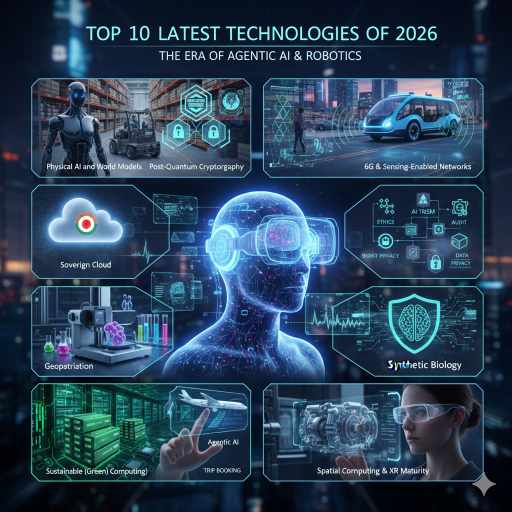
- Agentic AI (Autonomous Agents)
The era of simple chatbots is over. Agentic AI refers to systems that don’t just answer questions but execute multi-step tasks autonomously. In 2026, these agents manage entire workflows—from booking complex international travel to negotiating service contracts and managing corporate supply chains—with minimal human oversight. - Physical AI and World Models
Artificial intelligence has moved beyond the screen. Using World Models, AI now learns from video and spatial inputs to predict physical movement. This allows humanoid robots and autonomous systems to navigate unpredictable real-world environments with human-like intuition, fundamentally changing warehouse logistics and domestic assistance. - Post-Quantum Cryptography (PQC)
With “Quantum Advantage” now a reality, traditional encryption is vulnerable. 2026 has seen a massive enterprise shift toward Quantum-Resistant Algorithms. Companies are racing to implement PQC to protect sensitive data from being decrypted by nascent quantum computers, making it a cornerstone of modern cybersecurity. - Geopatriation and Sovereign Clouds
Due to rising geopolitical tensions, “Geopatriation” has become a major trend. Organizations are moving their data and AI workloads out of global public clouds and into Sovereign Clouds—local, regional environments that ensure data remains under the jurisdiction of a specific nation’s laws and regulations. - Synthetic Biology and Biomanufacturing
AI-driven biofoundries are now producing everything from carbon-negative building materials to lab-grown “brewed proteins.” By 2026, precision fermentation and enzyme engineering have scaled, allowing industries to manufacture complex chemicals and textiles with a fraction of the traditional environmental footprint. - AI TRiSM (Trust, Risk, and Security Management)
As AI agents make more independent decisions, the need for TRiSM has skyrocketed. This technology framework provides the governance, reliability, and data protection necessary to ensure AI models remain ethical and transparent. It is no longer optional; it is the regulatory standard for any enterprise AI deployment. - Sustainable (Green) Computing
The massive energy demand of AI data centers has forced a breakthrough in Green Computing. 2026 marks the widespread adoption of Sodium-ion batteries for energy storage and “Inference Economics,” where hardware-aware models are optimized to run on low-power accelerators rather than energy-hungry GPUs. - Brain-Computer Interfaces (BCI)
Once the stuff of science fiction, BCI technology has reached early-stage commercial viability in 2026. Beyond medical rehabilitation for prosthetic control, BCI is being integrated into high-end augmented reality (AR) systems, allowing users to interact with digital interfaces using thought and neural signals. - Spatial Computing and XR Maturity
With the release of more ergonomic, “all-day” wearable glasses, spatial computing has begun to replace the traditional laptop for field workers and designers. These devices blend digital twins of machinery directly onto the physical world, allowing for real-time, hands-free technical repairs and collaborative 3D modeling. - 6G Trials and Sensing-Enabled Networks
While 5G is the current standard, 2026 marks the first large-scale 6G trials. These networks use “Sensing-Enabled” technology, where the network itself acts like a radar, detecting the movement and location of objects without the need for dedicated sensors—essential for the safety of city-wide robotaxi fleets.
Would you like me to dive deeper into the technical architecture of any of these specific technologies?